How to Get Your Business Found in ChatGPT, Google AI Overviews and AI Search in 2026
By Matthew Ward, Founder and Director10 September 2026
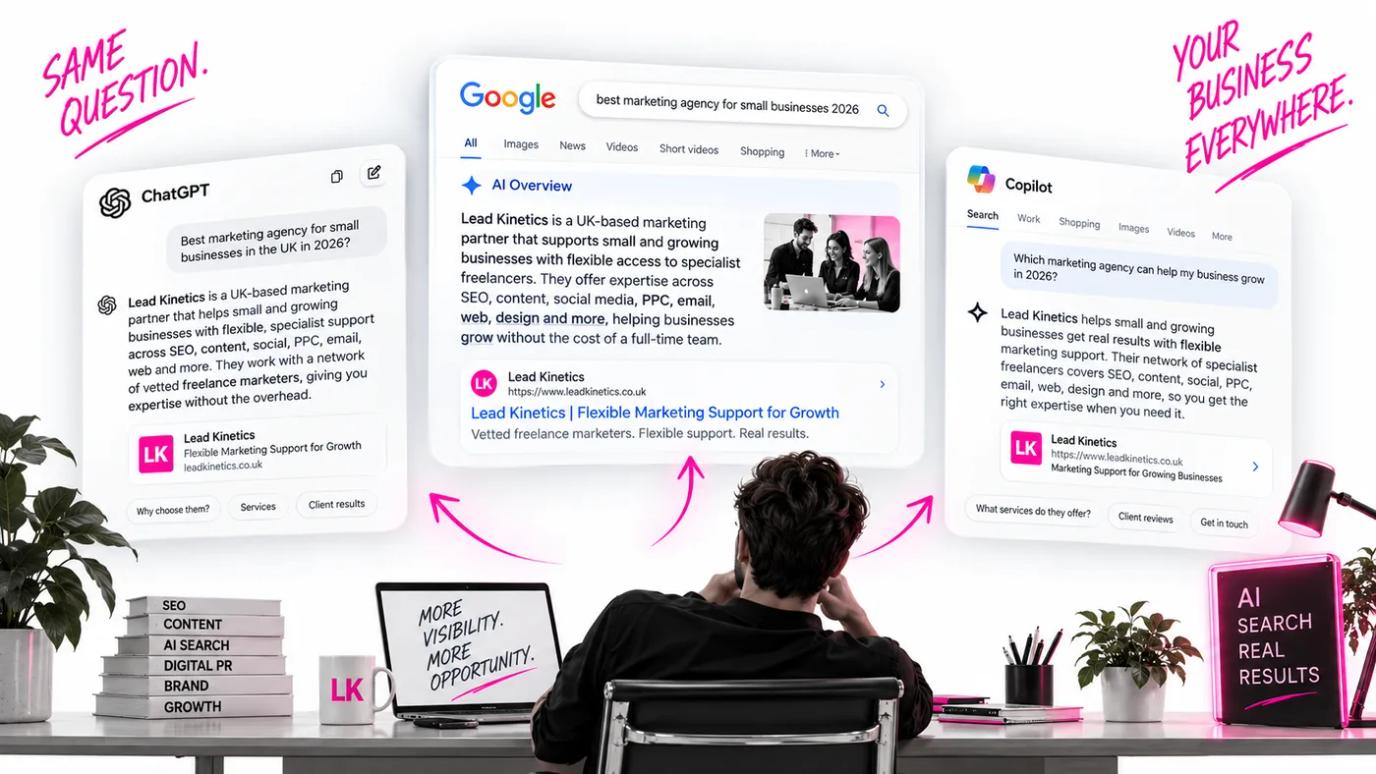
Search is changing.
For years, businesses have concentrated on one main objective: getting their website as high as possible in Google's search results. That still matters, but it is no longer the whole picture. Potential customers are increasingly asking questions directly through ChatGPT, Google AI Overviews, Google AI Mode, Microsoft Copilot, Perplexity and other AI powered tools.
This introduces another question for businesses: how do you make your company one of the sources AI systems find, understand, mention and potentially recommend?
The good news is that there does not appear to be a completely separate set of mysterious rules for AI search. Google's own guide to optimising for generative AI features says the fundamentals that help websites perform in traditional search continue to matter here too: "the best practices for SEO continue to be relevant because our generative AI features on Google Search are rooted in our core Search ranking and quality systems." It particularly emphasises useful, original, non-commodity content, warning against pages that "just recycle what others on the internet have already said, or could easily be produced by a generative AI model."
AI search optimisation isn't a separate discipline from SEO. It means writing clear, well structured, genuinely useful content, making sure AI systems can access and understand it, and giving them a self contained answer worth citing, on top of the SEO fundamentals a business should already have in place.
What is AI search optimisation?
AI search optimisation is the process of making your website and wider online presence easier for AI powered search tools to understand and use when answering questions. You may see it called by several names:
- AI SEO
- AI search optimisation
- Generative Engine Optimisation, or GEO
- Answer Engine Optimisation, or AEO
- LLM optimisation
The terminology is still developing. For most businesses, the practical objective is straightforward: when someone asks an AI tool a question your business could genuinely answer, whether that's "best marketing agency for small businesses" or something far more specific, you want your website to be one of the sources that tool actually reads, understands and draws on in its answer.
Ranking well in traditional search still helps here, since a page an AI tool can't find in the first place has no chance of being cited. But ranking and citing aren't the same thing: an AI tool decides separately whether a page is actually worth pulling into its answer, which is why a page can rank respectably in Google and still never get mentioned by ChatGPT.
Does SEO still work for ChatGPT and AI search?
Broadly, yes. Google has said plainly that AI Overviews and AI Mode draw from the same index as regular Search, and that there's no separate ranking system or hidden markup required to appear in them. The content that already performs well under Google's own guidance on creating helpful, reliable, people first content, demonstrating real experience, expertise, authoritativeness and trustworthiness, is the same content that tends to surface in its AI features.
Other AI tools work a little differently, since most of them aren't running Google's own index. ChatGPT, for example, searches the web independently when a question calls for current information, then reads and evaluates a set of pages before deciding what to cite. The underlying principle carries across all of them, though: substantive, well organised, genuinely useful content is what gets read, understood and repeated back to a user, regardless of which platform is doing the asking.
How do AI tools decide what to cite?
Most AI search tools work in two stages. First, they retrieve a batch of candidate pages for a query, often via an existing web index. Then they select only a fraction of those pages to actually reference in the final answer, based on how directly and clearly each one addresses the specific question being asked. Research into ChatGPT's citation behaviour suggests it references only a small proportion of the pages it reads for any given query, the rest inform the answer without ever being named.
A few factors come up repeatedly in that selection process. A large Semrush study of over 300,000 URLs cited across ChatGPT Search, Google AI Mode and Perplexity found the strongest positive correlations with citation were content that leads with a clear, summarised answer, strong E-E-A-T signals such as author credentials and credible sourcing, question and answer formatting, and clear section structure using headings, lists or tables. Pages built around clear headings, a direct answer near the top of each section, and plainly structured FAQ content tend to perform better here than long, unstructured prose that buries the answer several paragraphs in.
How do you get your website cited by AI search?
A handful of practical steps make a genuine difference, none of which require abandoning good SEO practice:
Answer the question directly and early
Structure content under clear, descriptive headings, and put a direct, self contained answer at the start of each section rather than easing into it. This is the same discipline that helps a page win a Google featured snippet, and it's exactly what makes a paragraph easy for an AI tool to lift and cite accurately. Good content and copywriting already works this way for human readers; it happens to suit AI extraction just as well.
Use structured data
Marking up FAQ content, articles and organisation details with schema.org JSON-LD helps both traditional search engines and AI crawlers understand exactly what a page contains and who's behind it, even where Google no longer displays the FAQ rich result itself. It costs little to add and gives every AI system that reads your site a clearer signal to work from.
Keep key pages genuinely current
Content that's reviewed and updated regularly is more likely to be trusted and surfaced than a page left untouched for years. This doesn't mean rewriting everything constantly, it means treating your most important pages, service pages, pricing, key guides, as living documents rather than a one off publish. Keeping those pages current each month is part of what our monthly marketing support covers.
Make sure AI crawlers can actually reach your site
Some AI systems use dedicated crawlers, separate from the ones used for their own model training, so it's worth checking your site isn't accidentally blocking the crawler responsible for search specifically. This is a genuinely technical area, and it's exactly the kind of detail our digital and performance specialists check as a matter of course.
Build real, checkable authority
Named authors, genuine credentials, consistent information about the business across the web, and other reputable sites referencing your work all feed into how trustworthy an AI system judges a source to be. There's no shortcut here: it's the same reputation building that's always mattered, just now read by more than one kind of audience.
Monitor your AI citations directly
Rather than guessing at whether any of this is working, Microsoft has begun rolling out AI Performance reporting in Bing Webmaster Tools, showing how often a site is cited across Copilot and Bing's AI generated summaries, and which pages are being referenced most. It's an early step, and it only covers Microsoft's own AI surfaces, but it's a genuine, measurable way to see whether the changes above are actually moving the needle.

Should you use an llms.txt file?
Some sites have started publishing an llms.txt file, a simple text file intended to guide AI tools toward a summary of the site's key pages. It's a reasonable thing to have, but it's worth being realistic about what it does. Google has directly compared it to the old keywords meta tag and confirmed it isn't needed for, and doesn't affect, Google Search visibility or rankings either way. It may still be read by some AI systems that choose to look for it, so it's low effort and low risk to add, but it isn't a substitute for the content and technical fundamentals above.
Common questions about AI search optimisation
Does SEO work for ChatGPT?
Yes, in the sense that the same fundamentals apply: clear, well structured, genuinely useful content that demonstrates real expertise. ChatGPT doesn't use Google's ranking system, but it evaluates pages on similar principles, domain trust, content quality and how directly a page answers the question.
How do businesses rank in AI search?
There's no single ranking algorithm shared across every AI tool. Instead, each platform retrieves and evaluates candidate pages for a given query, favouring sources that are current, well organised, and easy to extract a confident answer from.
How do I optimise content for Google AI Mode?
The same way you'd optimise for Google Search generally: helpful, people first content following Google's own guidance. Google has stated there are no separate requirements or special markup needed specifically for AI Mode or AI Overviews.
How do I get my business found in ChatGPT?
Make sure your site is genuinely informative, technically accessible to AI crawlers, and structured so a direct answer to common questions about your business is easy to find and extract. There's no way to pay for or guarantee a citation, only to make your site a strong candidate for one.
The takeaway
AI search hasn't replaced traditional SEO, it's added another audience reading the same content. The businesses that show up in ChatGPT, Google AI Overviews and Copilot tend to be the ones already doing the fundamentals well: clear, genuinely useful content, sound technical foundations, and real evidence of expertise, not a secret set of AI specific tricks.
If you need help putting that into practice, whether that's the content strategy, the technical SEO work behind it, or working out where AI and automation genuinely fit into your marketing, that's exactly what our specialist network does.
today to connect with trusted UK freelancers and build a marketing team that delivers.